Tuesday, December 1, 2009

Keys to Good Writing--48 of Them


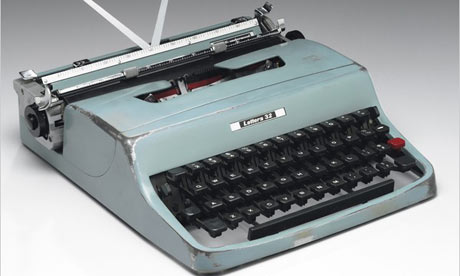
So Cormac McCarthy is selling his typewriter. Traditionalists need not fear: he's replacing it with another one. The retired machine, bought circa 1963, has just got a bit worn down after almost half a century of clacking away, churning out a dozen novels and a sheaf of other works.

Today the Guardian's Books Blog lists a few other old-school authors who still love their old-fashioned typewriters. Don DeLillo says "I need the sound of the keys...The hammers striking the page. I like to see the words, the sentences, as they take shape." Will Self says that with a typewriter, "You don't revise as much, you just think more, because you know you're going to have to retype the entire fucking thing." (I, and several of my fellow editors, believe that since the word processor came into widespread use, the tendency of manuscripts to balloon to excessive lengths has become more pronounced.)

I know exactly what DeLillo means about the sound of the keys. The photo of McCarthy's trusty Olivetti reminded me of my mother's Hermes Rocket, another slim but sturdy portable whose keyboard I gleefully bashed away at long before I knew how to actually read or write. I remember exactly how satisfying it felt to hear the clickety-clack and see the letters marching across the page. Who cared if they made words?

But when I learned how to make words of my own, using the typewriter got to be even more fun.  I even, at age 5 or so, wrote a very, very short novel titled "Sandy the Sandpail." I honestly don't remember the plot of S. the S., but I do remember chapter 6, because other members of my family have enjoyed, for decades, quoting it at me in its entirety:
"Sandy the Sandpail had a friend called Goldie. Nothing happened to Goldie."

Obviously, the use of the typewriter has influenced the elliptical style that Cormac McCarthy and I share.

Monday, November 30, 2009

A Grave in Provence


A few years ago, on a holiday in Provence, I dragged my family to the village of Lourmarin to visit the grave of Albert Camus. Lourmarin is a pretty, well-preserved medieval town, but the nondescript cemetery outside its walls must be its least alluring feature. The graveyard was hot, dusty, and indifferently tended. My wife recalls the place as "depressing." But for me it was, in Michelin-guide terms, worth the journey to pay my respects to Camus. 

There are not many authors I would classify as my heroes, but Camus is one of them. He was not just a superb writer, but a courageous man. Camus edited a Resistance newspaper during the occupation of France, and throughout his life consistently stood up for individual choice and dignity in the face of all forms of oppression and conformity--whether Stalinism, Naziism, or religious orthodoxy. 


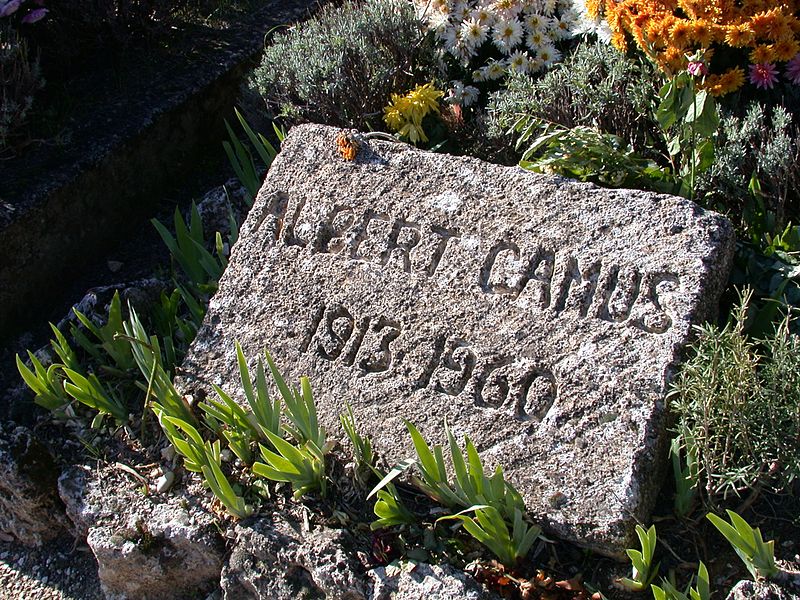
Camus' gravestone is simple and unadorned: just his name and dates. It took some time to find, because it was not specially marked.  I stood by the slab for a few minutes. In the hot August afternoon, the Provençal sun pressing down on my head, I thought of the shimmering heat of the beach in Algiers, indelibly rendered in The Stranger. The humility of this resting-place touched me; it seemed perfectly suited to the man who lay there.


Now France's president, Nicolas Sarkozy, is lobbying to move Camus' remains to the Panthéon, the imposing (some would say bombastic) tomb that holds other great men and women of France--Voltaire, Victor Hugo, Marie Curie. His plan has stirred a heated controversy. It seems like the rankest ploy of an unpopular politician hoping to appropriate the aura of a figure revered in France. But even if Sarkozy is acting from the best of intentions, to move Camus from his provincial grave to the Panthéon is a stunningly wrongheaded idea. While Camus' daughter has apparently assented to the scheme, his son Jean is sticking up for the Lourmarin cemetery. The move, he says "would be contrary to his father’s wishes and [he] does not want to have his legacy put to work in the service of the state." 


Jean is right. Camus should be allowed to remain in his quiet, sun-baked plot in the south of France--closer to his native Algeria and far from the machinations of the Elysée Palace. The Pantheon speaks of the greatness of France, but not the humanity of Camus. 

Thursday, November 26, 2009

Thanksgiving


I'll probably post briefly and irregularly over this holiday, as I'll be on the road visiting friends and loved ones. It occurs to me that as a publisher, I have many things to be thankful for (not least, at the moment, the fact that my company is healthy and I have a job). The thing I am most thankful for in my working life is that it has brought me into contact with so many smart, funny, interesting, and congenial people--colleagues, authors, booksellers, and readers. For all the transformations publishing is going through, I don't think that aspect of the business will ever change.

Wednesday, November 25, 2009

A Bit More on Darwin: How the Origin of Species Evolved

One more note on Darwin's The Origin of Species, whose 150th anniversary of publication was yesterday. The Origin was not just a scientific milestone, it was a publishing success story. It went through six editions in the space of 13 years after 1859. Darwin revised and expanded it from 150,000 to 190,000 words in response to the comments and critiques he received. (I was interested to learn that the word "evolution" did not appear until the sixth edition. I knew that it was the philosopher Herbert Spencer who coined the phrase "survival of the fittest," which he derived from Darwin's ideas; I didn't know that Darwin then borrowed it from him, including it in the fifth edition.)

Ben Fry has created an arresting animation that graphically unfolds the revision history of On the Origin of Species. Below is just a screenshot; the full animation is here.