I am really enjoying my venture in podcasting,
which gives me a chance to have stimulating conversations about history with a variety of authors. This month I spoke to Martha Hodes of NYU about her new
book Mourning Lincoln.
The murder of President Abraham Lincoln, just days
after the Union had triumphed in the Civil War, shocked and horrified people
across America—it was, in its way, a nineteenth century 9/11. This year, 2015, marks
the 150th anniversary of the assassination. Mourning Lincoln is Martha Hodes's exploration of that traumatic event.
Martha Hodes
She has combed through the private, unfiltered
writings of Americans from both North and South to learn how they reacted to
news of the assassination. Their responses both reflected how much Lincoln
meant to his contemporaries and revealed the profound differences that the
Civil War had left unresolved. Click the arrow above to hear my conversation with Martha Hodes about
her work; you can also download it at OnefortheBooks.net or via Soundcloud.
P.S. If you'd like to listen to my other interviews with historians, past or forthcoming, you can
subscribe via RSS feed on my podcast's home page, OnefortheBooks.net, linked above. You can
also follow me at Soundcloud. Or you can subscribe to this blog by
e-mail using the link in the right-hand column here, which will bring you all
my posts including announcements of new podcasts. Access via iTunes coming soon, I hope.
As a lover of history books, not to mention as an editor of them, I've wished for a long time that there were more conversation to be found online about all the interesting work that historians are doing. There are certainly some lively websites and blogs, and a handful of excellent podcasts, but the avid history reader is underserved compared to the fiction lover or sports fan.
I think this is slowly changing--for example, I've been happy to see a growing community of historians and history enthusiasts on Twitter. (One quick way to find the latter is search under the hashtag #Twitterstorians.) But it's still a challenge to find in-depth discussion of new work in history, especially as serious books reviews have so drastically diminished in newspapers and magazines.
So I'm making a modest effort to expand what's available with a new podcast, One for the Books, where I'll be talking to historians about their new titles, works in progress, and sometimes other topics. As I'm posting this on Independence Day, I could think of no better person to talk to than John Ferling, who has spent a long and productive scholarly career studying the American Revolution. He has just published a superb new book titled Whirlwind: The American Revolution and the War That Won It--a sweeping, and stirring, history of coming of American independence. Unlike many books on the Revolution, this one looks carefully at both the political struggle and the military one, and at how each of those influenced the other. Ferling also emphasizes--in a break from the last few decades of scholarship-- the economic factors that he believes drove the colonists toward a break from the mother country.
Click the orange button above to hear the interview. You can also download it from SoundCloud or from Libsyn. I hope you'll enjoy this talk as much as I did and that you'll check back for future interviews; you should soon be able to subscribe to the podcast via iTunes and other sites, and I'll update this post when those feeds are active. I would welcome comments, positive or negative, about this interview, or suggestions about other authors you'd like to hear on the podcast.
John Ferling
For more about John Ferling, or to buy Whirlwind, visit his website, which includes links to online and independent booksellers.
UPDATE- July 8, 2015: You can now find a dedicated webpage for this podcast at OnefortheBooks.net. You can subscribe to it via an RSS feed by clicking the symbol at the top of the podcast page, or by putting this URL into your RSS reader: http://oneforthebooks.net/rss. Soon it should also be available through iTunes and I'll update again then.
To subscribe by e-mail: if you don't have an RSS reader, but would like to be notified by e-mail of future podcast episodes, just sign up under the "Subscribe by E-mail" link at the right. That will bring you everything that's posted here, including new interviews.
We all know that what makes Wikipedia valuable, and also problematic, is that its entries can be edited at any time by any user. This makes it, on the whole, remarkably accurate--anyone who scorns Wikipedia as a mishmash of rumor and random errors should read about the study that found it stacked up pretty well against the Encyclopedia Britannica. But if it's terrificin the aggregate, for any given topic, at any given moment, Wikipedia is capable of delivering information that is factually wrong, politically skewed, or simply incoherent, depending on who was last on the "edit" page. Bridle's compilation of the Iraq War edits, I'm sure, will demonstrate this clearly. As he observes,
It contains arguments over numbers, differences of opinion on relevance and political standpoints, and frequent moments when someone erases the whole thing and just writes “Saddam Hussein was a dickhead.”
If you land on this Wikipedia page at the wrong time, you might find unhelpful "information" like that. But most of the time you'd get a lot of useful facts, 95 percent of them or better probably accurate. And as James Bridle points out regarding the Iraq War, the constant changing of the article is itself a valuable fact--a record of our historical knowledge as it lurches forward--or sometimes back.
This is what culture actually looks like: a process of argument, of dissenting and accreting opinion, of gradual and not always correct codification.
For anyone pondering the value of Wikipedia compared to "traditional" reference sources, an absolute must-read is an essay, now several years old, by the late Roy Rosenzweig, one of the pioneers of digital history, titled "Can History Be Open Source?" It's quite long and addressed principally to his fellow historians, but deeply thoughtful and open-minded. His overall assessment of Wikipedia is quite positive. He too compared Wikipedia to more established sources (Microsoft's Encarta and the American National Biography), using biographies as his sample, and concluded, 'Wikipedia is surprisingly accurate in reporting names, dates, and events in U.S. history."
Rosenzweig found that where the ANB was superior to Wikipedia was not so much in factual accuracy, but in the overall quality and richness of articles that draw on, instead of the wisdom of crowds, "the skill and confident judgment of a seasoned historian." Reading the Wikipedia entry on Abraham Lincoln next to the ANB article by James M. McPherson, he says
the difference lies in McPherson's richer contextualization [and] even more by his artful use of quotations to capture Lincoln's voice, by his evocative word portraits....and by his ability to convey a profound message in a handful of words.
Admittedly, putting Wikipedians up against James McPherson on Lincoln is sort of like sending the people sitting in the bleachers up to bat against C.C. Sabathia. This is only to say that encyclopedia entries, like any other kind of writing, are better done by a single talented person than by a committee, but it doesn't mean the committee version doesn't have value.
There is much more to Rosenzweig's article than this, and for anyone who's thinking about plunging into the nine volumes of The Iraq War, it would be a good place to start.
(Photo from James Bridle's Flickr set, reproduced under Creative Commons license)
In my first post on this blog I promised not to use the word "excited" more than once a month. But sometimes there's no other word to describe how an editor feels about a book. I've just published a new work of history that quickened my pulse from the first time I read the proposal: Rawn James, Jr's. Root and Branch: Charles Hamilton Huston, Thurgood Marshall, and the Struggle to End Segregation. This book tells one of the most important, most dramatic, yet least known stories in American history, and makes it not only exciting, but deeply poignant.
When we think of the Civil Rights movement, we tend to think of the 1950s and 60s, and scenes made famous by television-the bus boycott, the March on Washington, the Freedom Rides. But some of the most compelling, most dramatic, and most important victories took place long before then, in America's courtrooms, where two determined lawyers waged a decades-long battle against racial injustice.
The men were Charles Hamilton Houston and Thurgood Marshall, attorneys for the NAACP. From the 1930s to the 50s, they crisscrossed the country, going from backwoods county jails to the Supreme Court to fight for the legal rights of African Americans. In the Deep South, they sometimes slept in their car because no hotel would give them a room. They were heckled, threatened, and sometimes in danger of their lives. But in those days bigotry was not confined to the backwoods--it went all the way to the nation's capital. When Charles Houston argued his first case before the Supreme Court, one justice turned his chair to face the wall so he wouldn't have to look at a "colored" lawyer.
What the justices could not ignore was the razor-sharp arguments, and the relentless preparation, of Houston, Marshall and their colleagues. Case by case, slowly, methodically, but relentlessly, they dismantled the legal principle of "separate but equal" that had kept blacks as second-class citizens even after they emerged from slavery. Over some two decades, they laid the groundwork for the landmark Supreme Court ruling, Brown vs. Board of Education, that outlawed segregation in public schools and led to the collapse of Jim Crow. Without Houston and Marshall, there would be no Barack Obama.
These two great advocates are also a great pair of characters. Charles Houston was a stern, buttoned-down, no-nonsense guy. As a dean of Howard Law School, he turned it from a rinky-dink night school into a rigorous institution whose mission was to turn out the lawyers that could meet the white elite on equal terms. Marshall was his brightest student and his protégé, but in personality his opposite. Thurgood was casual. He loved to lean back and tell off-color jokes over a glass--or maybe a bottle--of bourbon. The two complemented each other perfectly. In effect, Thurgood became a surrogate son to Charlie. Sadly, Houston worked himself to death and died just before the Brown case, the one he'd been building toward, came to the Supreme Court. But Marshall did his mentor proud: not only did he win a historic victory in Brown, he would become the first African-American to join the Supreme Court.
Rawn James Jr. is a lawyer himself, and an heir to the great legacy laid down by Houston, Marshall, and those that followed. He tells this story with gusto, with a great sense of pacing and rhythm, and it truly comes to life in his pages. This is Rawn's first book but I'm sure it will not be his last. It's the debut of a dynamic new historian-and, yes, I'm excited by it.
(You can see Rawn talking about his book below, or visit his website, www.rawnjames.com, for more about Root and Branch.)
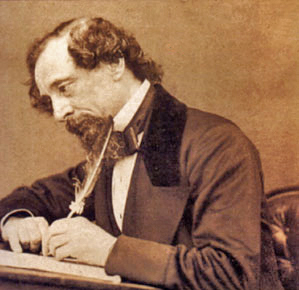
Why is protecting copyright important? Who can say it better than Charles Dickens, a colossally bestselling writer in his day whose works were shamelessly pirated in a developing country with scant respect for intellectual property: the United States.
Many of you are probably aware that Dickens's celebrated American tour of 1842 was prompted in no small part by his desire to make some money in the American market. His works were hugely popular here, but he earned not a nickel (or farthing) from their sale. By coming to the States he at least made some lucrative speaking fees. While he was here, he spoke out loudly in favor of an international copyright agreement--a topic that was not warmly received by his hosts. Then, as now, Americans considered themselves a specially moral nation; we really hate to have it pointed out when we don't live up to our ideals.
I spoke [Dickens wrote to a friend], as you know, of international copyright, at Boston; and I spoke of it again at Hartford. My friends were paralysed with wonder at such audacious daring. The notion that I, a man alone by himself, in America, should venture to suggest to the Americans that there was one point on which they were neither just to their own countrymen nor to us, actually struck the boldest dumb! Washington Irving, Prescott, Hoffman, Bryant, Halleck, Dana, Washington Allston -- every man who writes in this country is devoted to the question, and not one of them dares to raise his voice and complain of the atrocious state of the law. It is nothing that of all men living I am the greatest loser by it. It is nothing that I have a claim to speak and be heard. The wonder is that a breathing man can be found with temerity enough to suggest to the Americans the possibility of their having done wrong. I wish you could have seen the faces that I saw, down both sides of the table at Hartford, when I began to talk about Scott [Sir Walter, also hugely popular and widely bootlegged]...
I had no sooner made that second speech than such an outcry began (for the purpose of deterring me from doing the like in this city) as an Englishman can form no notion of. Anonymous letters; verbal dissuasions; newspaper attacks making Colt (a murderer who is attracting great attention here) an angel by comparison with me; assertions that I was no gentleman, but a mere mercenary scoundrel....
Dickens got as far west as St. Louis. But I was delighted to discover recently that, in the imagination of one screenwriter, he made it to Nevada. On a 1963 episode of the TV Western series Bonanza, Dickens read in Carson City--where he found the audience had his work memorized already--and in one remarkable scene, gave Hoss Cartwright an impassioned defense of intellectual property.
Yes, that's Jonathan Harris--better known as Dr. Smith of Lost in Space--as the great novelist. You can see him read from Oliver Twist here. To judge by Mark Twain's review of Dickens reading in New York, Harris may be better at the job than the great man himself.
Update: it is both ironic and probably inevitable that the YouTube clip of Dickens defending copyright has been removed because of copyright infringement! I recently saw it posted, however, on another YouTube page. Rather than give you another link that may go out of date, I suggest you search for the TV show under "Bonanza Charles Dickens" or the episode's title, "A Passion for Justice."
One more note on Darwin's The Origin of Species, whose 150th anniversary of publication was yesterday. The Origin was not just a scientific milestone, it was a publishing success story. It went through six editions in the space of 13 years after 1859. Darwin revised and expanded it from 150,000 to 190,000 words in response to the comments and critiques he received. (I was interested to learn that the word "evolution" did not appear until the sixth edition. I knew that it was the philosopher Herbert Spencer who coined the phrase "survival of the fittest," which he derived from Darwin's ideas; I didn't know that Darwin then borrowed it from him, including it in the fifth edition.)
Ben Fry has created an arresting animation that graphically unfolds the revision history of On the Origin of Species. Below is just a screenshot; the full animation is here.
150 years ago today, Charles Darwin's On the Origin of Species was published. Appropriately enough, Kurt Andersen, on public radio's Studio 360, is airing this week an interview with Denis Dutton, author of The Art Instinct: Beauty, Pleasure, and Human Evolution. Dutton's stimulating and erudite book looks specifically at human tastes in the arts, and argues that we need to think much more carefully about the way artistic values have been shaped by human evolution. The Art Instinct is a gleeful, two-fisted assault on much of the academic orthodoxy surrounding all the arts, but it's also full of deep and sincere appreciation of works ranging from Jane Austen's novels to Marcel Duchamp's notorious Fountain (the urinal Duchamp treated as a piece of art). It was one of the most widely reviewed books of the past year. I recommend it as a Christmas present for anyone you know who's interested in art, or at the same time, for readers who enjoy accessible explorations of evolutionary psychology--books by authors like Steven Pinker, Jared Diamond, or Richard Dawkins.
Click below to listen to Kurt Andersen interviewing Denis Dutton.
Or for something a bit lighter, but equally informative, you can see what happened when the philosophy professor met that highly evolved work of art, Stephen Colbert.
News reports say the President Obama is "soon" going to decide on a strategy for the U.S. in Afghanistan. While Obama and his military advisers ponder whether to continue the American presence there, and on what terms, there has been inevitably much discussion of Vietnam and the missteps we made there five decades ago. Evidently a few recent books about Vietnam are being avidly read around the Pentagon and West Wing, including Lessons in Disaster by Gordon Goldstein and A Better War by Lewis Sorley.
I have a better suggestion: Jungle of Snakes by James Arnold. Arnold looks not only at Vietnam, but three other counterinsurgency wars of the 20th century: the U.S. in the Phillippines at the beginning of the century; the British in Malaysia following World War II; the French in Algeria; and the U.S. in Vietnam. The first two of these were successful campaigns that defeated insurgencies, the second two were failures.
As many observers have pointed out, Afghanistan is different from Vietnam in many ways. Nor is it exactly like the other conflicts I just mentioned. But all counterinsurgencies have features in common, as Arnold's work makes clear--for instance, any counterinsurgency must begin by assuring security of the civilian population; the success of any campaign depends on quality intelligence; and no counterinsurgency can succeed in the absence of a central government that earns the population's trust.
Rather than obsessing over Vietnam--admittedly, the most painful wound in the nation's military psyche--our strategists might profitably expand their data pool by considering what has worked, or failed to work, in other settings as well. Arnold, a veteran military historian, crisply and dramatically conveys what it was like for American boys plunked down in a Phillippine jungle, or French officers trying to tell friend from foe in Algiers (where, disastrously, they resorted to torture). And he steps back to sort out some key principles that any commander facing outlaws and guerrillas needs to know. I recommend Jungle of Snakes to anyone who wants to understand the kind of "asymmetric conflict" our nation is likely to be involved in for the foreseeable future.
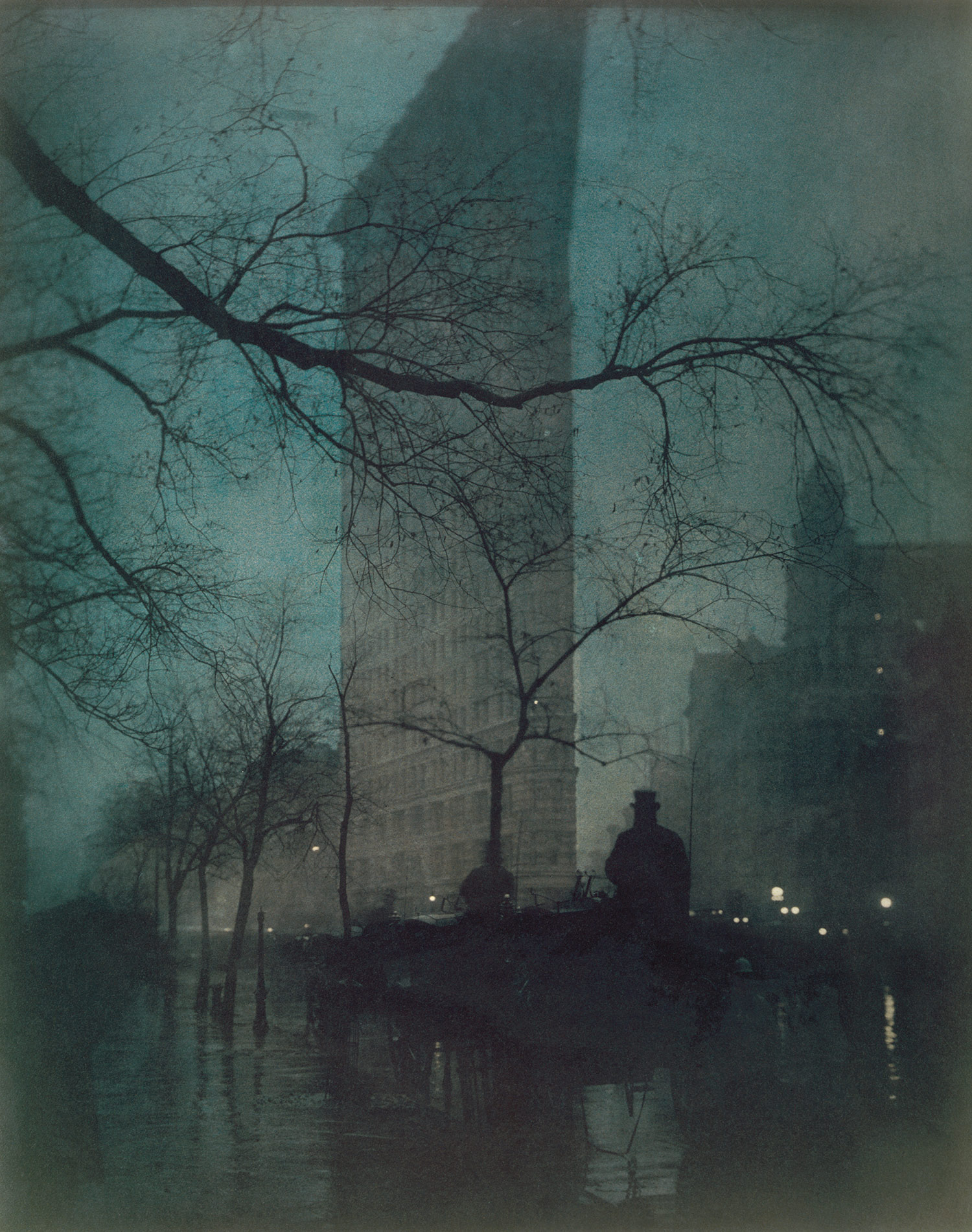
I've spent a significant portion of my publishing career in the Flatiron Building, first at St. Martin's Press and now at Bloomsbury. As many readers will have noticed the Bloomsbury Press logo alludes to the shape of the Flatiron. The FIB, as internal e-mails sometimes call it, is somewhat more wonderful to look at than to work in--it was built in 1902 and still has the same plumbing and heating--but it makes me happy every day to walk in the door of a New York landmark with so much character.
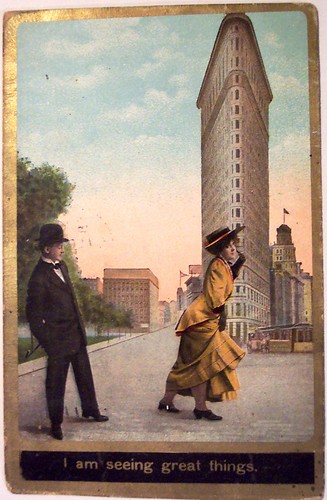
The Flatiron's unique appearance makes it one of the most photographed structures in New York and probably the world. The first of the photos above, by Edward Steichen, has been reproduced so often it is now a cliche'--but it's still lovely. I like the Steiglitz image below it, in which the photographer has found a tree that perfectly matches the shape of the building. But just yesterday, my colleague Pete Beatty discovered an equally wonderful picture online that reminds us why, according to urban lore, the intersection of Broadway and 23rd Street gave rise to the expression "23-Skidoo": this was where the cops had to shoo away fellows who would ogle the ladies.
P.S. Thanks to reader Tinker Greene who pointed out that the original version of this post I reversed the names of Steichen and Steiglitz. Even editors need editors.
I've promised not just to flack my titles on this page, but I did say I was going to tell you about them now and again. That's what makes you publish a book--the urge to share it with other readers.
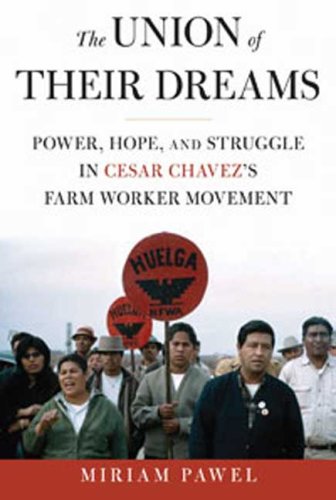
The one that's on my mind today is The Union of Their Dreams by Miriam Pawel. The Los Angeles Times reviews it this coming Sunday and calls it a "masterpiece." I agree. It reminds me of classics like Anthony Lukas’s COMMON GROUND, or Randy Shilts’ AND THE BAND PLAYED ON in the way it weaves a narrative from the stories of ordinary people that you come to care about intensely.
The story of Cesar Chavez and the United Farm Workers is one of the great American struggles for social justice, an astonishingly successful movement built from scratch. Miriam tells it through the experience of eight people who became key players in the UFW, from workers who learned organizing in the fields, to idealistic lawyers, ministers, and college kids. They found meaning and passion in "The Cause," and did incredible things, including leading the most effective consumer boycotts in history.
Robert Gray, the bookseller who writes one of the most astute and engaging blogs in the book trade, has a wonderful post this week at Shelf Awareness on "The Shame List." The Shame List includes "those backlist books every bookstore would be 'embarrassed' and even 'mortified' not to have in stock when a customer asks for them." He lists a few titles--some you might not expect--that are on his personal shortlist of books he'd hand-sell without even looking at the shelf. And he asks readers what titles are on their own Shame Lists.
I can’t remember where I saw this, but I once read a piece by an author about her “Middlemarch test.” If she went into a bookstore and it didn’t have Middlemarch, she knew the place was not up to scratch. Maybe that’s setting the bar too low, but I would certainly agree that if there’s no Middlemarch the backlist pickings are going to be slim.