I was intrigued to see the announcement a few days ago that Penguin USA is launching a new imprint, called Current, specializing in science titles. Its publisher, Adrian Zackheim, already heads two other imprints, Sentinel and Portfolio, devoted to conservative books and business books respectively. As Adrian observed in the press release, Penguin has had good success with niche publishing in those two areas: expanding into another niche seems like common sense.
To me there are two interesting features of this news. First, that Penguin is expanding its array of special-interest imprints (it has several other small lists in addition to the ones mentioned above). The estimable Mike Shatzkin has long argued that mastering niche audiences is the only viable future for publishing companies, and I think he may well be right. Penguin, with its vast and broad lists in paperback especially, is a long way from being a niche publisher--but are they beginning to steer the ocean liner in that direction?
And I'm pleasantly surprised to see that the area they have chosen to expand into is science. For some years now, popular science has been a category underserved by big publishers. Ten to fifteen years ago, in a great publishing tradition, every house in town piled into science books, chasing blockbuster successes like Stephen Hawking's A Brief History of Time and James Gleick's Chaos.
The inevitable result, after a couple of years in which there were some further, moderate successes while advances for science books went into the exosphere, was: the market was glutted and collapsed. Then, equally inevitably, the word went around the business,
"Science books don't sell." It became difficult for even a first-rate science book to find competitive bidders.
Of course, the audience for good, accessible science titles never went away--it was first surfeited, then starved, by publishers. Other categories have gone through similar cycles. After the rage for science, we had a rage for history books--then that bubble burst and we heard, "oh, you can't sell history any more." Anyway, Adrian Zackheim is a smart publisher, and if he thinks science is a category on the upswing he probably has some solid evidence. I enjoy reading, and editing, science titles so I'll keep an eye on Current with interest. Meanwhile, I and my colleagues at Walker & Co. have been quietly publishing popular science all along (as have several other fine editors elsewhere). We'll all be here to provide Penguin with some competition.
Tuesday, March 16, 2010
Two Books for St. Patrick's Day: the Irish in America, and an American in Ireland
With St. Patrick's Day upon us I have to toot the horn, or the uilleann pipes, for two books that every good son or daughter of Erin should know about--one that I published, one that I didn't.
The first is Jay P. Dolan's sweeping history The Irish Americans. It surprised me to learn, when I began talking to Jay about the book he was planning, that no general history of Irish-Americans had been written, at least for a trade audience, since the 1960s. Any field of historical research throws up new insights over such a span of time, but social history and ethnic history in particular have boomed in the past few decades. Jay, who had written pioneering works in this area, was an ideal author for the the topic. He drew on his own research and wove it together with the other recent scholarship in a richly colorful narrative.
The Irish Americans follows the Irish from their first arrival in the American colonies through the bleak days of the potato famine that brought millions of starving immigrants, right up to the election of JFK, the triumphant moment when an Irish American attained the White House. The book manages to evoke the ghastly ships crowded with men and women fleeing the potato blight; the backbreaking toil of Irish navvies digging the Erie Canal; vibrant life of Catholic parishes in cities like New York and Chicago; and the world of machine politics, where ward bosses often held court in the local saloon. It's a grand tapestry of the Irish experience in America, and I might add, the perfect gift for your Irish da, gran, or brother-in-law. Don't just take my word for it--the Wall Street Journal's excellent review is here.
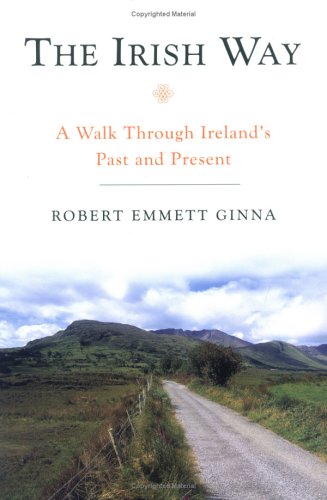
If you'd rather read about the old sod itself rather than its diaspora, you might seek out a lovely, more personal book, The Irish Way: A Walk Through Ireland's Past and Present. Full disclosure: the author is my Irish (-American) da, Robert Emmett Ginna. A few years ago he walked across the whole island, north to south. To stroll across the Irish landscape is to travel through time, so his account becomes a mosaic in which encounters with history and encounters with a profuse variety of present-day Irish characters are interspersed. (Again, don't take my word for it. James Salter wrote, "Ginna takes you along with him into the ruined abbeys, the villages and towns, the great houses with their extraordinary histories, the talk-filled pubs, and, more than this, into the soul of the country.")
Pour yourself a Jameson's, or if it's not that hour, brew a cup of tea--in my family we ask for it "strong enough to trot a mouse across"--and settle in.
The first is Jay P. Dolan's sweeping history The Irish Americans. It surprised me to learn, when I began talking to Jay about the book he was planning, that no general history of Irish-Americans had been written, at least for a trade audience, since the 1960s. Any field of historical research throws up new insights over such a span of time, but social history and ethnic history in particular have boomed in the past few decades. Jay, who had written pioneering works in this area, was an ideal author for the the topic. He drew on his own research and wove it together with the other recent scholarship in a richly colorful narrative.
The Irish Americans follows the Irish from their first arrival in the American colonies through the bleak days of the potato famine that brought millions of starving immigrants, right up to the election of JFK, the triumphant moment when an Irish American attained the White House. The book manages to evoke the ghastly ships crowded with men and women fleeing the potato blight; the backbreaking toil of Irish navvies digging the Erie Canal; vibrant life of Catholic parishes in cities like New York and Chicago; and the world of machine politics, where ward bosses often held court in the local saloon. It's a grand tapestry of the Irish experience in America, and I might add, the perfect gift for your Irish da, gran, or brother-in-law. Don't just take my word for it--the Wall Street Journal's excellent review is here.
If you'd rather read about the old sod itself rather than its diaspora, you might seek out a lovely, more personal book, The Irish Way: A Walk Through Ireland's Past and Present. Full disclosure: the author is my Irish (-American) da, Robert Emmett Ginna. A few years ago he walked across the whole island, north to south. To stroll across the Irish landscape is to travel through time, so his account becomes a mosaic in which encounters with history and encounters with a profuse variety of present-day Irish characters are interspersed. (Again, don't take my word for it. James Salter wrote, "Ginna takes you along with him into the ruined abbeys, the villages and towns, the great houses with their extraordinary histories, the talk-filled pubs, and, more than this, into the soul of the country.")
Pour yourself a Jameson's, or if it's not that hour, brew a cup of tea--in my family we ask for it "strong enough to trot a mouse across"--and settle in.
Sunday, March 7, 2010
When the Publisher Gets the Last Word, It's Often "Goodbye"
In my last post discussing why publishers, in general, don't fact-check their authors' work, I mentioned that it's accepted in the business that the author has ultimate say over the text. While an editor may request, urge, pester, or cajole an author to make a certain change (I have done all of the above), the author gets to say yes or no to it. But as one reader, Judith Ingracia, pointed out, that's not the whole story.
Publishers have one final recourse if the author refuses to make a change we think is critical: we can refuse to publish the book. Boilerplate contract language requires the author to deliver a manuscript that is "satisfactory" to the house. So if the author digs in her heels, and refuses to revise something that the editor feels will make the book unmarketable--or perhaps, may make it libelous or otherwise legally questionable--or again, let's say, untruthful--the author and publisher may simply part ways.
Judith asked,
In general, editors will sigh and let an author get away with some pretty misguided writing before they try reject a manuscript--threatening termination is so traumatic to an author that I at least rarely mention it unless it's a real possibility. In fact, with nonfiction, one would rarely cancel a book for mere differences of editorial opinion: it would most likely be over issues of veracity, accuracy, or legal liability.
Publishers have one final recourse if the author refuses to make a change we think is critical: we can refuse to publish the book. Boilerplate contract language requires the author to deliver a manuscript that is "satisfactory" to the house. So if the author digs in her heels, and refuses to revise something that the editor feels will make the book unmarketable--or perhaps, may make it libelous or otherwise legally questionable--or again, let's say, untruthful--the author and publisher may simply part ways.
Judith asked,
the book belongs to the author, but if the author wants a *published* book, he/she better listen to the publisher, at least that's what I gather. Am I mistaken in this view?Good question. My answer is, you're not mistaken, but the threat of cancellation is almost too blunt an instrument to use as a tool in editorial negotiations. canceling a book amounts to using the "nuclear option," laying waste to the whole project and vaporizing the time everyone has invested in it. (Quite likely vaporizing the publisher's money, too, as on-signing advances can be difficult to recoup.) I'm happy to say this situation has arisen very few times in own experience, but it has happened--it's very unpleasant for all parties involved.
In general, editors will sigh and let an author get away with some pretty misguided writing before they try reject a manuscript--threatening termination is so traumatic to an author that I at least rarely mention it unless it's a real possibility. In fact, with nonfiction, one would rarely cancel a book for mere differences of editorial opinion: it would most likely be over issues of veracity, accuracy, or legal liability.
(National Lampoon cover from January 1973,
photograph by Ronald G. Harris from a concept by Ed Bluestone)
Wednesday, March 3, 2010
Should Publishers Trust Their Authors? or, Hiroshima Mon Cul
[Thanks to the Huffington Post, which ran this piece on their lively Books page today. You may see future posts of mine there from time to time.]
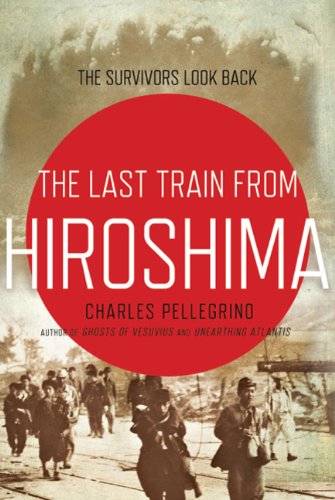
The kerfuffle of the week has been the news that an acclaimed new book, The Last Train from Hiroshima by Charles Pellegrino, had to be withdrawn by its publisher following the revelation that important details in it, including the testimony of a supposed eyewitness source, were apparently fabricated.
As happened in earlier cases of authors doctoring the truth, some readers have raised questions about "quality control" problems in publishing, and asked, don't publishers fact-check their products?
Well, no, actually. A major difference between book and magazine or newspaper publishing is that publishers don't have fact-checkers on staff, and never have. This is not, as some cynics might suppose, because book publishers don't care about accuracy as long as a book sells. It's partly because, unlike those media where advertisers support (or used to) a large editorial staff, book publishing has been a far leaner enterprise (or as some would say, a cottage industry). But a more important reason, I believe, is that in book publishing, unlike journalism, the content has traditionally belonged to the author, not to the house.
This is reflected in book contracts, where copyright is typically retained by the author; more to the point, it's firmly established in publishing culture that you never make editorial changes without an author's consent. As an editor you may lean pretty hard on an author to make revisions you feel are necessary (Gordon Lish's interventions with Raymond Carver being the extreme example)--but ultimately, "the book belongs to the author," and to change it or not is his or her prerogative. With that prerogative goes, inevitably, a greater responsibility for the quality of what you write.
Now, any good publisher wants to produce the best books possible. While we don't have fact-checkers, we have copyeditors who go through manuscripts with a fine-tooth comb, after the editor has already worked with the author to get the book in shape. I have done my own fact-checking from time to time when an author's statement seemed questionable, and the best copyeditors will frequently check sources as well as spelling and punctuation. Furthermore, any manuscript that might raise issues such of defamation or privacy goes through a careful legal review. In the end, though, we have to trust our authors.
I don't take on a work of nonfiction, especially a controversial or even unconventional one, without satisfying myself, perhaps just at gut level, that the author is presenting the truth responsibly. But I have to recognize that I can be fooled. Reading about the case of Charles Pellegrino, who supposedly produced--or at least, said he had--documentation of his bogus souce (who was a real person, but apparently not present at the event he claimed to witness), I suspect I might well have accepted the author's account.
Once we have decided to trust an author, we usually give him or her the benefit of the doubt on matters of fact just as on matters of style or argument. Of course, this leaves us vulnerable. But in book publishers' defense, the impulse to trust the people you work with is a hard one to overcome. Look at the cases of Janet Cooke, Stephen Glass, or Jayson Blair, whose fabrications sailed through the presumably gimlet-eyed fact-checking operations of the Washington Post, New Republic, and New York Times respectively.
The kerfuffle of the week has been the news that an acclaimed new book, The Last Train from Hiroshima by Charles Pellegrino, had to be withdrawn by its publisher following the revelation that important details in it, including the testimony of a supposed eyewitness source, were apparently fabricated.
As happened in earlier cases of authors doctoring the truth, some readers have raised questions about "quality control" problems in publishing, and asked, don't publishers fact-check their products?
Well, no, actually. A major difference between book and magazine or newspaper publishing is that publishers don't have fact-checkers on staff, and never have. This is not, as some cynics might suppose, because book publishers don't care about accuracy as long as a book sells. It's partly because, unlike those media where advertisers support (or used to) a large editorial staff, book publishing has been a far leaner enterprise (or as some would say, a cottage industry). But a more important reason, I believe, is that in book publishing, unlike journalism, the content has traditionally belonged to the author, not to the house.
This is reflected in book contracts, where copyright is typically retained by the author; more to the point, it's firmly established in publishing culture that you never make editorial changes without an author's consent. As an editor you may lean pretty hard on an author to make revisions you feel are necessary (Gordon Lish's interventions with Raymond Carver being the extreme example)--but ultimately, "the book belongs to the author," and to change it or not is his or her prerogative. With that prerogative goes, inevitably, a greater responsibility for the quality of what you write.
Now, any good publisher wants to produce the best books possible. While we don't have fact-checkers, we have copyeditors who go through manuscripts with a fine-tooth comb, after the editor has already worked with the author to get the book in shape. I have done my own fact-checking from time to time when an author's statement seemed questionable, and the best copyeditors will frequently check sources as well as spelling and punctuation. Furthermore, any manuscript that might raise issues such of defamation or privacy goes through a careful legal review. In the end, though, we have to trust our authors.
I don't take on a work of nonfiction, especially a controversial or even unconventional one, without satisfying myself, perhaps just at gut level, that the author is presenting the truth responsibly. But I have to recognize that I can be fooled. Reading about the case of Charles Pellegrino, who supposedly produced--or at least, said he had--documentation of his bogus souce (who was a real person, but apparently not present at the event he claimed to witness), I suspect I might well have accepted the author's account.
Once we have decided to trust an author, we usually give him or her the benefit of the doubt on matters of fact just as on matters of style or argument. Of course, this leaves us vulnerable. But in book publishers' defense, the impulse to trust the people you work with is a hard one to overcome. Look at the cases of Janet Cooke, Stephen Glass, or Jayson Blair, whose fabrications sailed through the presumably gimlet-eyed fact-checking operations of the Washington Post, New Republic, and New York Times respectively.
(Photo of the Bocca della Verita, or Mouth of Truth, at the Church of Santa Maria in Cosmedin in Rome, via Wikimedia Commons. It's said that if you tell a lie with your hand in the mouth of the sculpture, it will be bitten off. Maybe every publisher needs one of these?)
Subscribe to:
Posts (Atom)