Saturday, February 13, 2010

Recalled to Life: Kirkus Reviews Finds a Surprise New Owner

Kirkus Reviews, the pre-publication review outlet, was expected to close a few weeks ago, but has now had a reprieve. As Daily Finance reports, the business has been sold to shopping-center mogul, and bookstore owner, Herb Simon, better known for owning the Indiana Pacers. This may seem odd news, but it's good news. As I said in an earlier post, with the huge number of titles clamoring for attention (and often going with virtually none), any service that can help pick some needles out of the haystack is really useful. 


Kirkus will keep its editors and continue to publish bi-weekly. It plans to "beef up" its digital offerings--where there should be plenty of opportunities. Kirkus at one time licensed its reviews to Amazon--I wish they would again, to complement the, er, less gimlet-eyed notices from PW I often find there. Or wouldn't you like to have, say, an app on your iPhone that would deliver a pithy, one-screen-size review of a book you're leafing through in a bookstore? Kirkus would be well suited to that. 


We'll wish the rescued Kirkus success--and hope that their near-death experience may make them a little kinder toward the books they review. Just not kind enough to be boring. 


(image by Phiz from A Tale of Two Cities

Friday, February 12, 2010

Cutting Through Some of the Nonsense about E-Book Prices

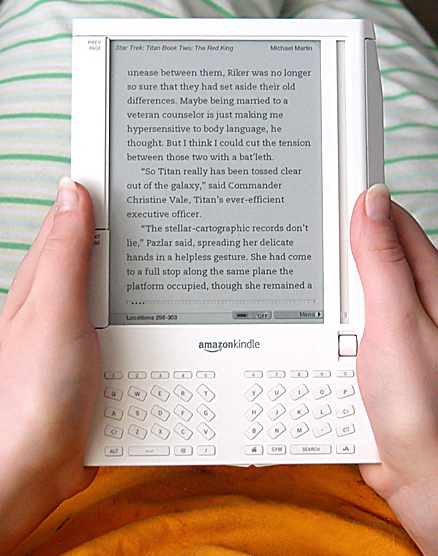
I’ve been trying not to let e-books monopolize this page, but it’s a subject that’s hard to avoid with so much happening. This week we had a New York Times article about the ever-contentious topic of e-book prices, on which vast quantities of hot air are expended.
The Times notes that many readers are complaining, not to say outraged, about the idea of paying more than $9.99 for e-books—the price that Amazon has aggressively promoted in its effort to sell Kindles. 

At Publishers Lunch, his indispensable blog/newsletter, Michael Cader had a terrific piece yesterday debunking some notions implicit in the NYT article, and urging publishing people do to a better job of explaining to the public the widely held fallacies about e-book prices. I’ll write more about this myself, but his points are so cogent that I might as well start by quoting some of them:  

* $9.99 never was the top e-book price; people pay more than that every day
[When there was no Kindle, many e-books, including those for Sony Reader cost well above $9.99. And from the beginning of the Kindle store, plenty of titles were above that price. As Cader notes elsewhere, three recent surveys, two presented at Digital Book World, one this week by Goldman Sachs, strongly suggest that while price is important to e-book buyers, there are—as you’d expect--more important elements to a buying decision, such as author reputation.]

* The implicit, false promise of cheap e-books was made by the people who profit, at very nice margins, from selling the devices, not by publishers. Please blame them if you feel deceived.  [Right. Amazon has sold “millions” of Kindles by Jeff Bezos’s account. Which means, at the prices they charge, they are raking in hundreds of millions on Kindle hardware. Was it a coincidence that Amazon had its biggest profits ever last year?]

* Publishers are lowering their ebook prices
Most stories say publishers are raising prices. We in the trade know that publishers are preparing to lower their ebook prices by 50 percent or more, and reduce their own profit margins. But customers don't; they hear that publishers are raising prices. [Another key point. Publishers are actually looking to take less per book than they have been getting from Amazon. And in general e-book list prices are coming down.]

* The new "top price" is going to be $12.99 more often than not
[Cader notes that this will depend on what deals publishers arrive at with Apple, but in general we’re talking about a rise of a couple of dollars.]

Cader’s piece also makes one other important point:

Publishers are hoping to protect smaller and local retailers and ensure that customers have a wide range of real bookstores and online e-bookstores to choose from.

Right again. Low prices are a weapon used by big, deep-pocketed merchants, typically chains, to crush their small, local competitors. Publishers don’t want to see a marketplace that consists of nothing but Amazon and Barnes & Noble. This is, to be honest, partly because most of us in the business have a sentimental attachment to old-fashioned bookstores, the kinds of places where most book-lovers love to hang out.  It is partly because we know that it’s in those independent stores that surprise, hand-sold hits can catch fire and turn into bestsellers. But it’s also because we don’t want to find ourselves with nothing but 600-pound gorillas for customers.

Tuesday, February 9, 2010

The Perfect Book to Read in a Blizzard: Cro-Magnon, the Story of Ice Age Humans

With the mid-Atlantic region recovering from one blizzard and bracing for another, we might be forgiven for wondering whether, instead of worrying about global warming, we ought to be learning how to make igloos. Let me call your attention to the perfect book to read after shoveling three feet of snow off your walk: Brian Fagan's Cro-Magnon: How the Ice Age Gave Birth to the First Modern Humans.

Cro-Magnon people were the first fully modern Europeans. We know them best for their stunning cave paintings at Lascaux, Altamira and elsewhere. But the Cro-Magnons were not just artistically gifted; they were ingeniously inventive. In fact they were the most adaptable and technologically creative people that had yet lived on earth. They lived side by side with an older species, Neanderthals, for some 15,000 years. In the end, the Cro-Magnons were better able to cope with the changing climate as the ice age blanketed Europe: they had better tools, better communication, and warmer clothes. They survived and Neanderthals faded away.

I really enjoy working Brian Fagan, an archaeologist who has a gift rare in his profession for bringing the prehistoric past to life. He can evoke the mystery of a cave flickering with torchlight, or the hesitant, wordless encounter of a Cro-Magnon hunting party and a Neanderthal settlement. A few pages later he can explain the cutting-edge techniques scientists use to date and interpret artifacts or tiny fragments of bone. And he can provide illuminating insights into the ingenuity of humans, revealing how what seem like simple innovations could push human history forward. For instance, what tool--probably more important than the wheel--allowed our Cro-Magnon ancestors to make it though the frigid winters of the Ice Age? The needle. With a sliver of bone pierced at one end, it was possible to sew together hides or furs and make real clothes. Imagine shoveling your walk, or chasing a deer, while trying to keep a bear hide draped over your shoulders and you'll see pretty clearly why this is important. 

If you have enjoyed the works of Jared Diamond--or for that matter, Clan of the Cave Bear and its bestselling sequels, I think you'll find Cro-Magnon an absorbing read. Here's a brief interview with Brian about the book. (Someone said he looks "like Indiana Jones's dad." I think she's got a point there.) 


(For more information on Brian Fagan and his other books, including the New York Times bestseller The Great Warming, visit www.brianfagan.com.)

Thursday, February 4, 2010

New Advances in Bookselling Metrics: The Saltometer

Looks like we may have a major snowstorm in New York and the Mid-Atlantic in the next few days. Bad weather is always tough on retailers, bookstores included. But I learned from the excellent bookselling blog, Shelf Awareness, that at least one bookstore has found a hidden benefit to winter precipitation: a new customer "metric."
Although the current trend in bookselling is toward ever more computerized inventory control systems, Boswell Book Company, Milwaukee, Wis., shared its unique customer tracking device, known as the Saltometer:
"When there's a heavy snowfall in Milwaukee, it means one thing: massive piles of salt on the sidewalks of our fair city," noted the Boswellians blog. "We here at Boswell welcome it, of course. Not only does it keep the sides of Downer Avenue clear for pedestrians (come on by and see us!), it allows us booksellers to use that most hallowed of marketing tools: the saltometer. What is the saltometer, you ask? It's a highly sophisticated system by which we can look at the white-lined footprints all over the store and see what sections are really the most popular. Sure, we know what books you're all buying, but what about the books you read while you linger in the store on a frosty evening? Yes, the saltometer is the bookseller's friend."
New York City is not supposed to be hit very hard by the storm. I'm secretly disappointed. What could be better than getting snowed in for a day or two with a big pile of books to read?


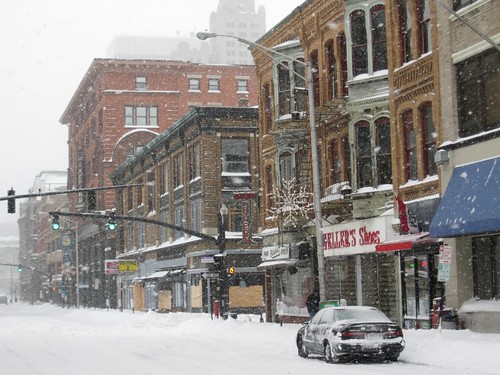
(Photo of Washington Street, Providence by Jef Nickerson from Flickr)