Thursday, December 3, 2009

What Publishing Needs Much More Of : Failure


The Twittersphere, or at least publishing's corner of it, has been chattering about Rick Moody's experiment with Twitter-fiction--an original story, "Some Contemporary Characters," that he wrote and posted in tweet-size increments over three days, commissioned by the innovative journal Electric Literature. I won't rehash the details of what happened (see accounts here   or here), but for various reasons the venture seems to have attracted a great deal of negative commentary on Twitter and elsewhere. Vroman's Bookstore, which joined the project by co-streaming the story, dropped out midway:  They reflect on the experience here, calling the project a "noble failure."  A blog post at Telereads asks,"Twitter a flop as a book promoter? Or just a failure with SOME books?"

Maybe the Moody project was a failure. If so, my reaction is: HOORAY! What we need in publishing today is much more failure. The one thing people in the industry can agree on is that the current methods of doing business are showing diminishing returns. The only way we're going to arrive at new methods is by trying dozens, scores, hundreds of new ways of reaching readers, building awareness, and ultimately selling content. Of course, some, probably most of these won't work, but it's through large-scale, repeated failure that we're going to find out what succeeds. As Clay Shirky puts it, "Failure is free, high-quality research, offering direct evidence of what works and what doesn't."

However, I would argue that "failure" is the wrong word to apply to Moody's Twitter story. In science, an experiment is only a failure if you don't learn something from it. Simply reading the comments on the Vroman's post one can see that a few basic tweaks  to how the story was presented (like adding hashtags) could have avoided many of the problems that bothered readers. Electric Literature can do it better next time. (And one commenter says they attracted thousands more followers thanks to the story, which is surely a success for them.) Twitter may not be a great new medium for fiction but it may yet be a great way to attract the interest of readers.

By the way, I personally thought "Some Contemporary Characters," as a story, was well worth reading-- intriguing, sometimes funny, and sometimes touching. Try reading it in its entirety in the @ElectricLit Twitter stream (and remember to read upward from the first post, dated 10:04 on November 30th). Maybe it wasn't a masterpiece, but I'd say Rick Moody is to be applauded, rather than criticized, for making the effort.

Someone asked Wayne Gretzky how he became the most prolific scorer in hockey, and he answered, "I figured it out. I missed a hundred percent of the shots I didn't take." 


(Photo from Thereifixedit.com)


Wednesday, December 2, 2009

Risky Business


If I weren't careful I could spend all day just surfing blogs about writing and publishing (and sometimes I have)--there's an astonishing amount of commentary out there, much of it worth reading, and more than I can keep up with. I just recently discovered the blog of literary agent Nathan Bransford, who offers frequent and savvy posts about the book business and very good advice for writers.

In a recent report on a tour of New York publishing houses, Bransford talks about the buzz phrase of the moment, "moving the needle," which is tossed around by editors looking for blockbuster books. Only the phrase is new--commercial houses have been obsessed with big books for some time.

And in the comment thread he nicely phrases the paradoxical situation of much commercial publishing now:
I think the weak link right now is that publishers are increasingly taking huge risk and shying away from small risks.
Publishing is always going to be a risky business. Publishers should take risks. I'd even say that by and large, the best publishers are the ones who take the most risks (successful risks, that is; the ex-publishers are the ones who take the wrong risks....) But the perceived need for blockbuster books, for some companies, pushes them to chase books that seem to be potential blockbusters, even if that means overpaying for them one after another--and overpaying for those titles means overpaying by hundreds of thousands, or millions, of dollars. 


The industry, and readers, might be better served by more houses taking a greater number of modest risks--on new authors, titles with niche or regional markets,  word-of-mouth, hand-sell kinds of books.  There are serious challenges in the "small ball" business model, too, which I'll talk about in an upcoming post.  But it's a workable one.  

Tuesday, December 1, 2009

Keys to Good Writing--48 of Them


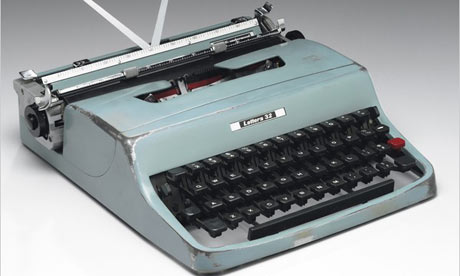
So Cormac McCarthy is selling his typewriter. Traditionalists need not fear: he's replacing it with another one. The retired machine, bought circa 1963, has just got a bit worn down after almost half a century of clacking away, churning out a dozen novels and a sheaf of other works.

Today the Guardian's Books Blog lists a few other old-school authors who still love their old-fashioned typewriters. Don DeLillo says "I need the sound of the keys...The hammers striking the page. I like to see the words, the sentences, as they take shape." Will Self says that with a typewriter, "You don't revise as much, you just think more, because you know you're going to have to retype the entire fucking thing." (I, and several of my fellow editors, believe that since the word processor came into widespread use, the tendency of manuscripts to balloon to excessive lengths has become more pronounced.)

I know exactly what DeLillo means about the sound of the keys. The photo of McCarthy's trusty Olivetti reminded me of my mother's Hermes Rocket, another slim but sturdy portable whose keyboard I gleefully bashed away at long before I knew how to actually read or write. I remember exactly how satisfying it felt to hear the clickety-clack and see the letters marching across the page. Who cared if they made words?

But when I learned how to make words of my own, using the typewriter got to be even more fun.  I even, at age 5 or so, wrote a very, very short novel titled "Sandy the Sandpail." I honestly don't remember the plot of S. the S., but I do remember chapter 6, because other members of my family have enjoyed, for decades, quoting it at me in its entirety:
"Sandy the Sandpail had a friend called Goldie. Nothing happened to Goldie."

Obviously, the use of the typewriter has influenced the elliptical style that Cormac McCarthy and I share.

Monday, November 30, 2009

A Grave in Provence


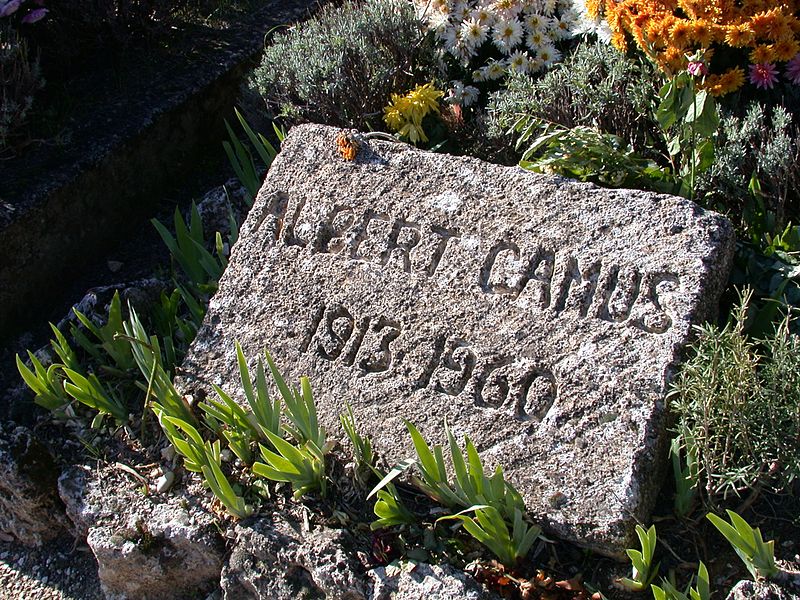
A few years ago, on a holiday in Provence, I dragged my family to the village of Lourmarin to visit the grave of Albert Camus. Lourmarin is a pretty, well-preserved medieval town, but the nondescript cemetery outside its walls must be its least alluring feature. The graveyard was hot, dusty, and indifferently tended. My wife recalls the place as "depressing." But for me it was, in Michelin-guide terms, worth the journey to pay my respects to Camus. 

There are not many authors I would classify as my heroes, but Camus is one of them. He was not just a superb writer, but a courageous man. Camus edited a Resistance newspaper during the occupation of France, and throughout his life consistently stood up for individual choice and dignity in the face of all forms of oppression and conformity--whether Stalinism, Naziism, or religious orthodoxy. 


Camus' gravestone is simple and unadorned: just his name and dates. It took some time to find, because it was not specially marked.  I stood by the slab for a few minutes. In the hot August afternoon, the Provençal sun pressing down on my head, I thought of the shimmering heat of the beach in Algiers, indelibly rendered in The Stranger. The humility of this resting-place touched me; it seemed perfectly suited to the man who lay there.


Now France's president, Nicolas Sarkozy, is lobbying to move Camus' remains to the Panthéon, the imposing (some would say bombastic) tomb that holds other great men and women of France--Voltaire, Victor Hugo, Marie Curie. His plan has stirred a heated controversy. It seems like the rankest ploy of an unpopular politician hoping to appropriate the aura of a figure revered in France. But even if Sarkozy is acting from the best of intentions, to move Camus from his provincial grave to the Panthéon is a stunningly wrongheaded idea. While Camus' daughter has apparently assented to the scheme, his son Jean is sticking up for the Lourmarin cemetery. The move, he says "would be contrary to his father’s wishes and [he] does not want to have his legacy put to work in the service of the state." 


Jean is right. Camus should be allowed to remain in his quiet, sun-baked plot in the south of France--closer to his native Algeria and far from the machinations of the Elysée Palace. The Pantheon speaks of the greatness of France, but not the humanity of Camus.