Showing posts with label Poetry. Show all posts

Thursday, December 24, 2009

A Christmas Poem: Thomas Hardy's "The Oxen"


One more poem for the Christmas break.


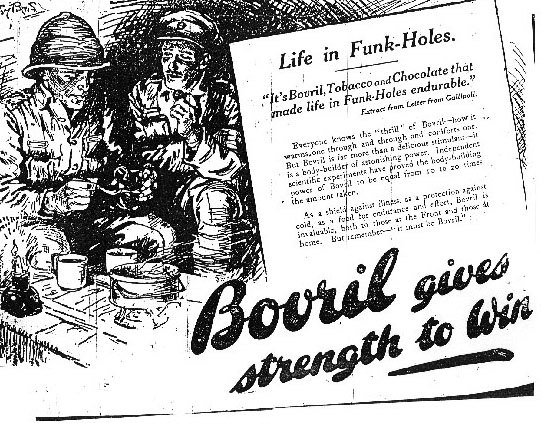
Thomas Hardy's "The Oxen" was first published on Christmas Eve, 1915. It was printed in the Times of London, cheek by jowl with news of the horrific conflict that was ravaging Europe; nearby was the advertisement shown below, touting Bovril as the tonic for men in the trenches. The second line refers to the folk belief that farm animals kneel at midnight on Christmas Eve. I have always loved the understatement of this poem, which seems even more poignant in a time when "holiday mix" blares from the speakers in every mall (and war is still ravaging).

 Christmas Eve, and twelve of the clock.
"Now they are all on their knees,"
An elder said as we sat in a flock
By the embers in hearthside ease.

We pictured the meek mild creatures where
They dwelt in their strawy pen,
Nor did it occur to one of us there
To doubt they were kneeling then.

So fair a fancy few would weave
In these years! Yet, I feel,
If someone said on Christmas Eve,
"Come; see the oxen kneel,

"In the lonely barton by yonder coomb
Our childhood used to know,"
I should go with him in the gloom,
Hoping it might be so.


There's an interesting article at The Victorian Web about the poem and its context (including the ad, with its "sacramental" portrayal of Bovril).
 

Saturday, November 21, 2009

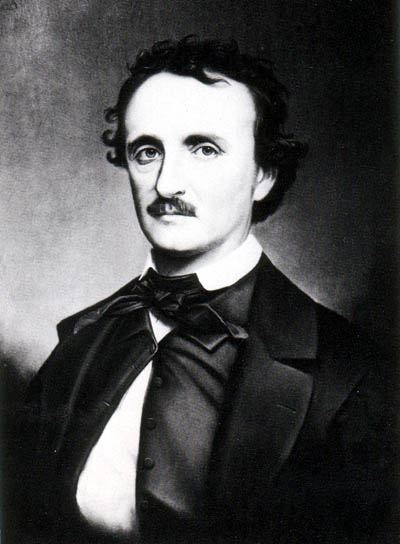
Hanging Out with Poe, Coleridge, and Terry Jacobus


A recent post by Mike Shatzkin about "verticals" (a key publishing topic that I'll write more about later) led me to PoetrySpeaks.com. This is a really interesting new site that brings together all sorts of content for poetry lovers, including not just the text of classic and new poems, but audio recordings and in some cases videos. You can read or listen to Shelley's Ozymandias, Poe's The Raven, or Tennyson's Charge of the Light Brigade. (The sound quality on the latter is so poor I wonder whether it's a very early recording of Tennyson himself? Fascinatingly, it's listed as the most popular poem on the site.). You can hear contemporary poets reading their work. Or you can even upload your own spoken-word recordings to a section called "YourMic."

Speaking of Poe, an unexpected benefit of being in the Twitterstream is that I learned about the funny and poignant poem below from a tweet. Here are just the first few lines.


So Edgar Allan Poe Was In This Car
Terry Jacobus

So Edgar Allan Poe was in this car goin' the wrong way on ol' 66
and it's snowin' hard and he's pissed off and worried about
everything so he manages to pull over to the side and his woman
gets outta the car to check out the situation but Edgar won't get
out and his woman realizes that he isn't gettin' out so she goes
to wunna them phone stands near a big pole by the Wrong Way
sign
And calls up his friend Sam Coleridge and Sam says, "Okay,
Hold on, I'll be right out there." ...

The full text (and audio) is on PoetrySpeaks here.

Friday, November 13, 2009

The Power of the Spoken Word (Rogue Edition)

In case you missed this the first time around, as I did, and in honor of her forthcoming memoir: William Shatner performs the poetry of Sarah Palin.

Saturday, November 7, 2009

In Spite of Fires on the Horizon


The publishing industry has been through ups and downs many times before, and has faced numerous challenges, yet books continue to be written, published and read. Whenever people are fretting about e-books or bookstore closings, I find reassurance in this poem by Czeslaw Milosz, which reminds me that books have been here for a long time and will be here after all of us worrywarts are gone. 
I confess there's a part of me that wonders if these words are still true in the age of Kindle. The oldest physical book I know of is 2500 years old, while the longest projected lifetime of any digital medium today is about 100 years. Will books always "be there on the shelves"? I can't be certain. But if I look at the novel I'm reading now on my iPhone, it still seems to be "derived from radiance." 
Perhaps if Milosz wrote in a hundred years' time, the line would say "the books will be there in the cloud." That seems no less poetic. 


And Yet the Books

And yet the books will be there on the shelves, separate beings, 

That appeared once, still wet 

As shining chestnuts under a tree in autumn, 

And, touched, coddled, began to live 

In spite of fires on the horizon, castles blown up, 

Tribes on the march, planets in motion. 

“We are,” they said, even as their pages 

Were being torn out, or a buzzing flame 

Licked away their letters.
So much more durable

Than we are, whose frail warmth 

Cools down with memory, disperses, perishes.

I imagine the earth when I am no more: 

Nothing happens, no loss, it’s still a strange pageant, 

Women’s dresses, dewy lilacs, a song in the valley. 

Yet the books will be there on the shelves, well born, 

Derived from people, but also from radiance, heights.

(From New & Collected Poems 1931-2001 by Czeslaw Milosz, Ecco)

Wednesday, November 4, 2009