Friday, December 11, 2009

The Value of Prepub Reviews, or Why We're Going to Miss Kirkus


There was some wailing, and some gloating, at the news announced today that Nielsen, parent company of Kirkus Reviews, was closing the publication. Kirkus was one of the four sources of "advance," or prepublication, book reviews (along with Library Journal, Booklist, and Publishers Weekly). Those who gloated, like ICM agent Esther Newberg, noted that Kirkus was the prepub review most likely to be negative: in fact it was often kind and sometimes effusive, but it's true that the other three prepubs were less willing to slam a book.

Ironically, consumers at large often think that Kirkus or its kin are puff machines, simply because the only time the "reader in the street" sees a quote from Kirkus or PW, it's on a book jacket. All the prepubs are capable of a stern critique, but of course when Kirkus says a novel is "jejeune" or your bio is "boring," you don't see that on the back cover.

The truth is, it's precisely because they are sometimes negative that the prepubs have value. With thousands of titles being published every year, book editors, news producers, movie scouts--anyone trying to make sense of the tsunami of books--are desperate for anything that can help them weed through it.  Chip McGrath of the New York Times said, almost plaintively,
"At the very time that we're inundated with stuff, that's the moment when you also need some gatekeepers, tastemakers, guides. Not that any of these are foolproof, but without them, it's just sort of chaos. How do you get your head around it at all?" Booksellers and others commenting on the web and Twitter today had similar sentiments.

The former managing director of Kirkus wonders "whether the industry still needs advance reviews the way it used to. Like it or not, they’re worth less every day in a world where everyone’s sister’s friend has a handle or a blog like Readermommy or Bookluvah."

It seems to me that is exactly the point. Because there is such a cacophony of voices out there, where it could be the author's "sister's friend" touting a book, we need more services like Kirkus, not fewer. Especially because so many other trusted venues, such as newspaper and magazine book reviews, have also disappeared. I published a book--an excellent one, if I say so myself--this year that received only one single review. Yes, it was from Kirkus.

I'm honestly a bit surprised that, in this age of information overload, a viable business model can't be found for a service that provides quick, pithy, trusted reviews of forthcoming books. We keep hearing that the skill of "curation" and "filtering" is what is most in demand in a limitless marketplace. That's what the prepubs do. Kirkus may have been idiosyncratic or even unkind from time to time, but how is that different from any other reviewer?

I suspect that even those who have shed no tears for Kirkus Reviews may find they miss it when it's gone.

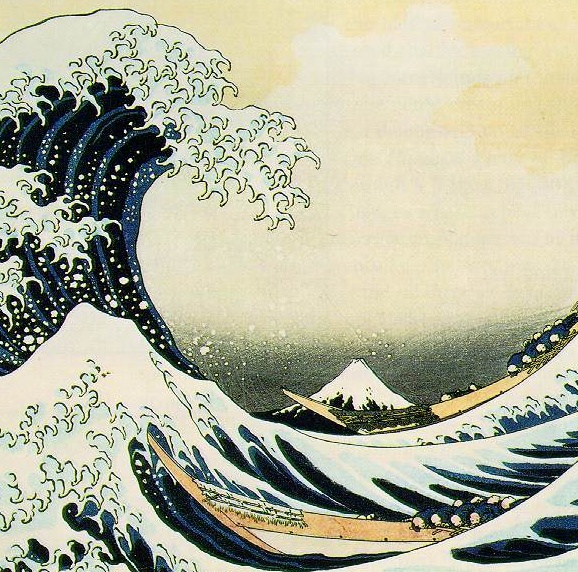
(Illustration: Hokusai, The Great Wave of Kanagawa)

Tuesday, December 8, 2009

What E-Readers Will Never Replace


Mor liked to tear a book apart as he read it, breaking the back, thumbing and turning down the pages, commenting and underling. He liked to have his books close to him, upon a table, upon the floor, at least upon open shelves. Seeing them so near and so destroyed, he could feel that they were now almost inside his head.   
--Iris Murdoch, The Sandcastle


The Kindle and other e-readers have received an obsessive degree of attention in the press this year, with some people declaring the Kindle a great leap forward (see Jacob Weisberg in Slate) and others saying it's not nearly as good as a book. Nicholson Baker test-drove one for The New Yorker and found it disappointment: the screen "wasn’t just gray; it was a greenish, sickly gray. A postmortem gray." 

I'm a little surprised that so far, all the commentary I have read both pro and contra e-readers has focused almost entirely on the reading experience. Most people agree that a printed book--especially a well-designed, well-printed one--is more pleasurable to read, but Kindle partisans love the convenience of carrying many books in a one-book-sized package, not to mention the instant availability of so many titles. I was a Kindle early adopter and I can still remember the first time, stuck in an airport lounge, I zapped a book into my hands out of the ether. It felt like something out of Harry Potter. 


But as any book lover knows, the act of reading a book is only part of your experience of it. You have a relationship with the volume itself, not just with the text it contains. And the physical book, in fact, becomes the symbol of that relationship--in the precise sense that it partakes of what it signifies. When I sit in my armchair and look at my bookshelf across the room, the spines of each volume I've read summon up memories and sensations just as if I were going through a photo album.  

When I think of books I have loved, what comes to mind is not disembodied words, but the actual books. I can remember the way the type lay on the page, the feel of paper and binding in my fingers. But the intensity of my feeling for certain books isn't the product of their aesthetic quality--my disintegrating, shoddy paperback of Le Grand Meaulnes is just as numinous as four elegant hardcover volumes of Virginia Woolf essays that I have preserved much more carefully.

I have always felt slightly disappointed in myself as a reader because I treat books rather gently, unlike Iris Murdoch's Mor, who ravages his books in the course of reading them. It is only by almost destroying the printed pages that he gets them "inside his head." This passage captures something primal about how, in an almost literal sense, we consume writing. You can't consume an e-book quite the same way.


Don't get me wrong: I think my Kindle is great--and reading Kindle books on the iPhone, which I can carry in my pocket, is even better. For me, it's not while I read them, but afterward, that e-books fall short.  

Not only do I remember that magical moment in the airport lounge. I also remember when I turned, or rather clicked, the last page of my first Kindle purchase. Suddenly the book was gone--vanished back into the ether. Perhaps possessing books "in the cloud" alone is a purer way of appreciating literature. But I hope I will not be accused of Luddism or fetishizing print if I say that much as I love my Kindle, the satisfaction of closing a wonderful book and slipping it into a shelf in my library, where I can enjoy its company, will never be equaled by the satisfaction of watching a screen go blank.


(photo of Neil Gaiman's library via Shelfari.com)

Monday, December 7, 2009

Book Trailers: Two More Worth Watching


I posted about book trailers yesterday with a somewhat disparaging comment about how often they fail to sell me on the titles in question, but it would be fairer to say that as with any promotional device, there are hits and misses. Here are two more trailers that totally won me over. It's interesting that one looks very elaborately produced (lots of photoshop, animation, original art--all brilliantly executed), and one could hardly be simpler. But both, I think, are highly effective.

Sunday, December 6, 2009

Book Trailers: From the Sublime to the Sublimely Ridiculous


While I firmly believe that publishers need to make greater use of the internet for marketing, I am often skeptical of video book trailers. Few of them have actually made me want to go buy a book. But occasionally one succeeds brilliantly. This one, from the New Zealand Book Council for Maurice Gee's Going West, is so dazzling you almost wonder whether the book can live up to it. But it was enough to make me order a copy.

On the other hand, it seems almost superfluous to create a trailer for Sense and Sensibility and Sea Monsters, Quirk Books' followup to Pride and Prejudice and Zombies. They had me at "Sea Monsters." Still, if you've sat through enough hours of Masterpiece Theater, this bit of Regency gone awry is hard not to enjoy:


Do you think trailers are effective at selling books? Let me know about examples that you think have done the job.