Friday, March 26, 2010

What "Fair and Balanced" Meant When FDR Was a Journalist

Guest post: John Q. Barrett is a professor of law at St. John's University and a scholar who is writing the biography of one of America's great Supreme Court justices, Robert Jackson. John discovered and edited (and I published) a wonderfully engaging memoir by Jackson of his friend Franklin D. Roosevelt, titled That Man. John maintains an e-mail listserv that features news and comment about Jackson and his times. It seemed particularly poignant, in this week of war-by-soundbite over health care, to read the following message, which John Barrett has allowed me to repost here. 


In summer 1928, a time of pitched policy debates and impending electoral contests, a New York State lawyer who was active in Democratic Party politics began to write occasional pieces for his local newspaper.

The column was called “Between Neighbors.”  In his first output, the columnist explained that his writing would be “more or less serious,” and that it would be aimed at his politically diverse upstate neighbors:

These neighbors of mine are a representative cross-section of the community, and are made up of Republicans, Democrats and people who are not affiliated with any party.  Therefore in talking about politics, I am keeping that fact in mind and have no intention of using the shop-worn methods of condemning everything on one side and praising everything on the other side of the political fence.

The day has gone by when you can fool people into believing that the nation, or a state or a country or a city is going to the dogs just because one political party happens to be in power in it.  People are sick of the kind of editorial writing which sees only good in every measure and every man sponsored by one party and only bad on the other side.  So, too, it is the little provincial papers that today in the news-columns magnify as first page news any disagreements in their opponents’ camps and run only a half inch on the back page about any trouble in their own camp.

That is one reason why the bitterly partisan press is losing its influence in this country.  The other reason is that there is more and better education everywhere and readers do not as much as formerly take the views and news of a one-sided paper as Gospel Truth.  I told [the local newspaper editor] I hoped he would get some Republican to write each week in this paper, but if he can’t find one, I shall try to be as fair as I can.

Although these ideas were as wise and fitting in 1928 as they are today, the lawyer did not, in the end, have much time to live up to them as a newspaper columnist.  He earlier had held political office.  That fall, after publishing ten columns in two months, he gave up the pastime to accept his party’s nomination to be a candidate.  (Robert H. Jackson, another upstate New York lawyer who was the candidate’s friend but also had a more booming law practice, became involved sporadically in the campaign.)

That November, the former Beacon Standard columnist, Franklin D. Roosevelt, was elected governor of New York.  In that office and in his next office, he got, at least sometimes, the fair and balanced media coverage that leaders and policies, and also we neighbors in the audience, deserve.

Thursday, March 25, 2010

Doctor Dolittle's Dog, or, An Editor's-Nose View of The Future

My favorite passage from The Story of Doctor Dolittle describes how the doctor's faithful (and very intelligent) dog Jip takes in the world through his nose. He's on a ship far out at sea at the time:
 
Then Jip went up to the front of the ship and smelt the wind; and he
started muttering to himself,

"Tar; Spanish onions; kerosene oil; wet raincoats; crushed
laurel-leaves; rubber burning; lace-curtains being washed--No, my
mistake, lace-curtains hanging out to dry; and foxes--hundreds of
'em--cubs; and--"

"Can you really smell all those different things in this one wind?"
asked the Doctor.

"Why, of course!" said Jip.  "And those are only a few of the easy
smells--the strong ones. Any mongrel could smell those with a cold in
the head.  Wait now, and I'll tell you some of the harder scents that
are coming on this wind--a few of the dainty ones."

Then the dog shut his eyes tight, poked his nose straight up in the air
and sniffed hard with his mouth half-open.

For a long time he said nothing.  He kept as still as a stone.  He
hardly seemed to be breathing at all.  When at last he began to speak,
it sounded almost as though he were singing, sadly, in a dream.

"Bricks," he whispered, very low--"old yellow bricks, crumbling with
age in a garden-wall; the sweet breath of young cows standing in a
mountain-stream; the lead roof of a dove-cote--or perhaps a
granary--with the mid-day sun on it; black kid gloves lying in a
bureau-drawer of walnut-wood; a dusty road with a horses'
drinking-trough beneath the sycamores; little mushrooms bursting
through the rotting leaves; and--and--and--"

"Any parsnips?" asked Gub-Gub.

"No," said Jip.  "You always think of things to eat.  No parsnips
whatever." 

I think a good editor is like Jip. The job is about sticking your nose into the wind and trying to figure out what's out there. Your sense of the marketplace, or of what's happening in the literary world, comes at you not in a sharp, high-def picture, but a jumble of impressions and images, some of which you can read more clearly than others.


It's the same for me with the future of publishing. I have a pretty potent whiff, for example,  of an explosion of e-books and e-readers for the next few years. But I can't yet smell on  the wind the future for bookstores, which are surely challenged by this development. I have caught distinct notes that the digital marketplace is going to start erasing the distinction between books and magazines, but no scent of what that means for writers or book editors. One thing I can say for sure: the wind on deck in publishing offers a bouquet at least as rich and confusing as the breeze in Jip's nostrils.

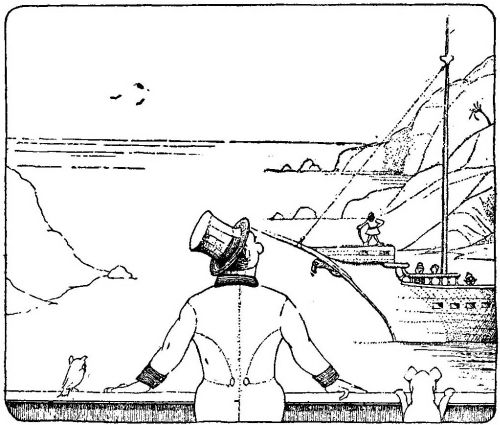
Illustration by Hugh Lofting from The Story of Doctor Dolittle

Wednesday, March 24, 2010

Looking into the Future: Partially Obstructed View

I have already referred on this page to a classic children's book, Hugh Lofting's The Story of Doctor Dolittle. I thought of it again this past weekend, when I attended the Writing the Future conference at the Writers' Center of Bethesda, organized by Creative Nonfiction magazine.* I joined a  group of panelists discussing various topics around the central theme: that question we have all been asking ourselves for some time now, What's going to happen to writing and publishing in the digital age? 

There were several sharp and articulate presenters:  Creative Nonfiction will be posting information and videos from the conference on Facebook, and many of the key points can be plucked from the Twitter stream of attendees here. 

Nonetheless, this gathering brought home to me once again: nobody knows what the future of publishing is. In some sense, editors are always hoping to guess the future, to anticipate what people are going to want to read about a year or two down the road. But it's a chancy business, because as I said at the conference, to make such guesses based on the present or recent past is a great way to be disastrously off base. A mistake our industry repeats over and over is rushing to sign up books on a topic that's all over the news today. Alas, when that book comes out a year or two from now, the hot subject du jour is yesterday's news. And I mentioned in my last post, publishers who decided at one point that science was a hot category quickly glutted the market and made it ice cold. 

Predicting the future of reading or writing--what kind of devices will be used, what kind of writing will sell (long or short, fiction or memoir, etc., etc.), what can be "monetized" and how--is even more challenging than predicting the sales of a book on Bernard Madoff or the Tea Party, because there are so many more variables.  I came away from the conference reinforced in my enduring belief that fresh ideas and good stories, well told, will always have an audience, and a market. As my fellow panelist (and, full disclosure, Bloomsbury author) Pagan Kennedy pointed out, Thoreau's Walden would have made a terrific blog.

So what does this have to do with Doctor Dolittle? More on that tomorrow. 


*Creative Nonfiction has just revamped its format and its first new-look issue is out, featuring Dave Eggers, Richard Rodriguez, Bill McKibben, Carolyn Forche, and others.  Take a look here.

Tuesday, March 16, 2010

Most Interesting Publishing News of the Week: Penguin Launches a New Science Imprint

I was intrigued to see the announcement a few days ago that Penguin USA is launching a new imprint, called Current, specializing in science titles.  Its publisher,  Adrian Zackheim, already heads two other imprints, Sentinel and Portfolio, devoted to conservative books and business books respectively. As Adrian observed in the press release, Penguin has had good success with niche publishing in those two areas: expanding into another niche seems like common sense.

To me there are two interesting features of this news. First, that Penguin is expanding its array of special-interest imprints (it has several other small lists in addition to the ones mentioned above).  The estimable Mike Shatzkin has long argued that mastering niche audiences is the only viable future for publishing companies, and I think he may well be right. Penguin, with its vast and broad lists in paperback especially, is a long way from being a niche publisher--but are they beginning to steer the ocean liner in that direction?

And I'm pleasantly surprised to see that the area they have chosen to expand into is science. For some years now, popular science has been a category underserved by big publishers. Ten to fifteen years ago, in a great publishing tradition, every house in town piled into science books, chasing blockbuster successes like Stephen Hawking's A Brief History of Time and James Gleick's Chaos.

The inevitable result, after a couple of years in which there were some further, moderate successes while advances for science books went into the exosphere, was: the market was glutted and collapsed. Then, equally inevitably, the word went around the business,
"Science books don't sell." It became difficult for even a first-rate science book to find competitive bidders.

Of course, the audience for good, accessible science titles never went away--it was first surfeited, then starved, by publishers. Other categories have gone through similar cycles. After the rage for science, we had a rage for history books--then that bubble burst and we heard, "oh, you can't sell history any more." Anyway, Adrian Zackheim is a smart publisher, and if he thinks science is a category on the upswing he probably has some solid evidence.   I enjoy reading, and editing, science titles so I'll keep an eye on Current with interest. Meanwhile, I and my colleagues at Walker & Co. have been quietly publishing popular science all along (as have several other fine editors elsewhere). We'll all be here to provide Penguin with some competition.